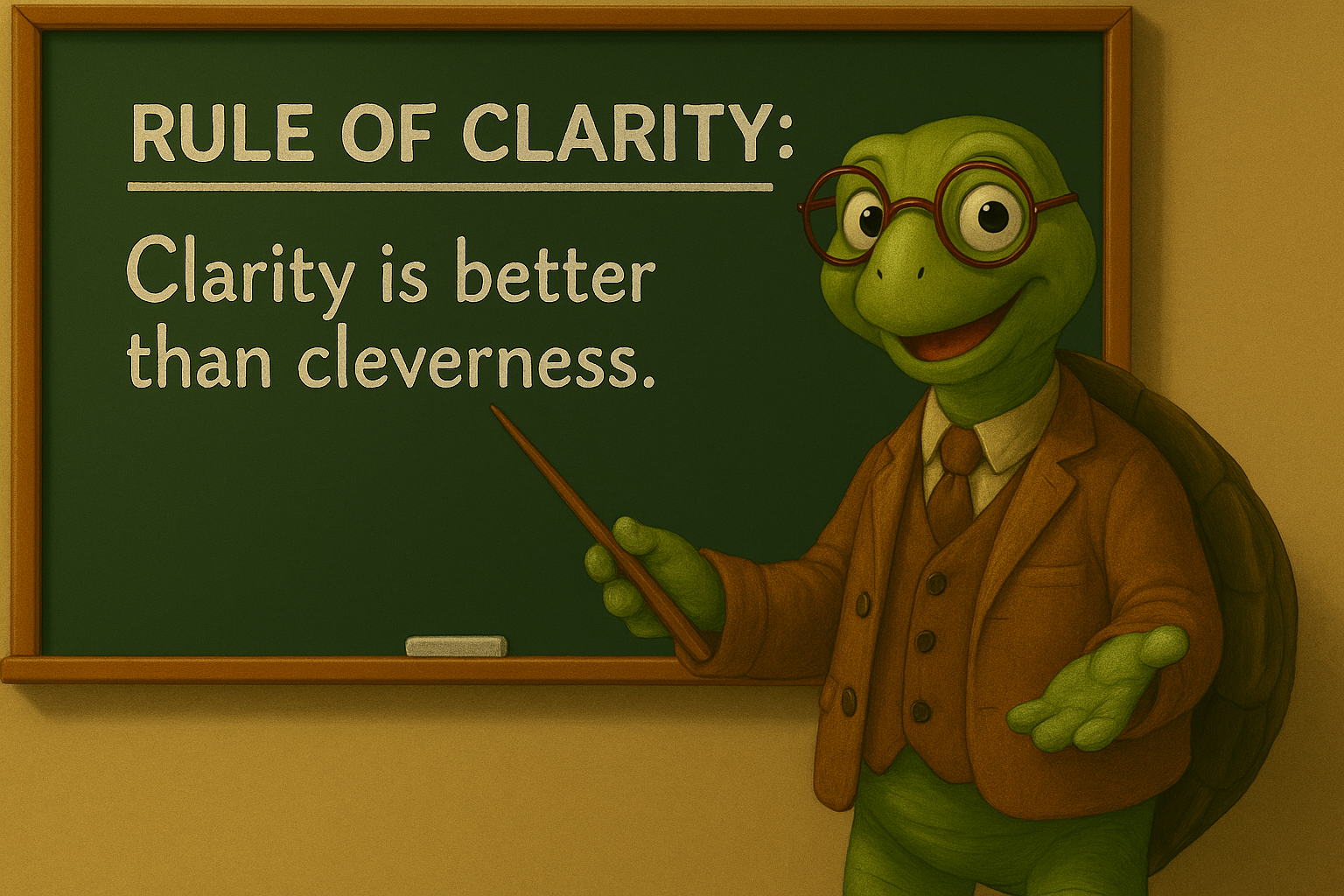

The Rule of Clarity: Clarity Is Better Than Cleverness
Introduction
In software development we’re constantly tempted to write code that dazzles—dense one‑liners, clever recursion tricks, or obscure LINQ pipelines. While those solutions can be impressive in a code review, they often become liabilities later on. The Rule of Clarity reminds us that clarity is always preferable to cleverness. Clear code is easier to read, debug, maintain, and extend. In this article we’ll explore why clarity wins, how to apply the rule in everyday software development, and look at some concrete code examples that illustrate the trade‑off.
Why Cleverness Is a Double‑Edged Sword
| Aspect | Clever Code | Clear Code |
|---|---|---|
| Readability | Requires mental gymnastics to understand intent. | Expresses intent directly; future readers (including yourself) grasp it instantly. |
| Debugging | Hidden side‑effects or subtle bugs are hard to locate. | Straightforward flow makes stepping through a debugger painless. |
| Team Collaboration | New team members spend extra time deciphering tricks. | Everyone can contribute confidently without a steep learning curve. |
| Refactoring | Small changes risk breaking hidden assumptions. | Simple, modular pieces adapt gracefully to new requirements. |
Even seasoned engineers admit that a clever snippet that works today can become a nightmare tomorrow. The cost of maintaining such code usually outweighs any short‑term elegance gains. Code should be very easy to reason over with very low cognitive load.
Guiding Principles for Writing Clear Code
- Prefer Explicit Over Implicit: Use descriptive variable names and avoid hidden magic.
- Break Down Complex Logic: Split long methods into smaller, well‑named functions.
- Leverage Language Features Wisely: LINQ and expression‑bodied members are powerful, but only when they improve readability.
- Document Intent, Not Implementation: Comments should explain why something is done, not restate what the code already shows.
- Write Tests That Describe Behavior: Unit tests serve as living documentation for the expected outcome.
There are many more than these five. If you haven’t read Clean Code by Robert “Uncle Bob” Martin, I highly recommend it. Some folks are very critical of its content, but the thing to remember is these are tools in the toolbox, not dogmatic rules. Apply what makes sense for the project. The goal, however, never changes–readability to support maintainability.
Code Examples
A “Clever” One‑Liner vs. a Clear Multi‑Step Version
Clever (hard to read)
// Returns the sum of the squares of all even numbers in the list.
int result = numbers.Where(n => n % 2 == 0).Select(n => n * n).Sum();
Why it’s problematic:
- Combines three operations in a single line.
- A reader must parse the lambda expressions and understand the pipeline instantly.
Clear (step‑by‑step)
IEnumerable<int> evenNumbers = numbers.Where(IsEven);

IEnumerable<int> squaredEvens = evenNumbers.Select(Square);

int result = squaredEvens.Sum();

bool IsEven(int n) => n % 2 == 0;
int Square(int n) => n * n;
Benefits:
- Each transformation is named (IsEven, Square).
- The flow mirrors natural language: filter → transform → aggregate.
- Future modifications (e.g., logging each step) are trivial.
Avoiding Over‑Engineered Recursion
Clever recursive solution (obscure)
int Fib(int n) => n <= 1 ? n : Fib(n - 1) + Fib(n - 2);
Issues:
- Exponential time complexity; hidden performance problem.
- Stack overflow risk for larger n.
Clear iterative version (readable & efficient)
int Fibonacci(int n)
{
    if (n < 0) throw new ArgumentOutOfRangeException(nameof(n));
    if (n == 0) return 0;
    if (n == 1) return 1;

    int previous = 0, current = 1;
    for (int i = 2; i <= n; i++)
    {
        int next = previous + current;
        previous = current;
        current = next;
    }
    return current;
}
Why this is clearer:
- Explicit loop conveys the algorithmic intent.
- Complexity is obvious (linear).
- Edge cases are handled up front, improving safety.
LINQ: When It Helps, When It Hinders
Over‑clever LINQ (hard to follow)
var report = orders
    .GroupBy(o => o.CustomerId)
    .Select(g => new { Customer = g.Key, Total = g.Sum(o => o.Amount) })
    .OrderByDescending(x => x.Total)
    .Take(5);
Clearer, broken‑down version
var ordersByCustomer = orders.GroupBy(o => o.CustomerId);

var totalsPerCustomer = ordersByCustomer.Select(g =>
    new CustomerTotal
    {
        CustomerId = g.Key,
        TotalAmount = g.Sum(o => o.Amount)
    });

var topFiveCustomers = totalsPerCustomer
    .OrderByDescending(ct => ct.TotalAmount)
    .Take(5);

record CustomerTotal(Guid CustomerId, decimal TotalAmount);
Now each stage is labeled, making it easy to insert logging, error handling, or additional filters without untangling a dense chain.
Practical Tips to Enforce the Rule
- Code Reviews: Encourage reviewers to ask, “Can this be expressed more clearly?”
- Linters & Analyzers: Tools like SonarQube or Roslyn analyzers can flag overly complex expressions.
- Pair Programming: Explaining code aloud often reveals hidden cleverness that should be simplified.
- Documentation Culture: Treat the repository’s README and inline comments as part of the public contract—if you’d need a comment to understand the code, refactor it.
Conclusion
Cleverness may win applause in a hackathon, but in production software clarity is the true champion. By writing code that reads like a story—explicit, modular, and well‑named—you reduce bugs, speed up onboarding, and future‑proof your projects. Adopt the Rule of Clarity today, and let your code speak plainly to anyone who reads it, including your future self. Clear boring code wins every time.
Cheers!